West Meets East
Whilst on a recent visit to Beijing I was lucky enough to spend time with a Traditional Tui Na Master: Dr Xunying Huang. Tui Na (Twee Na) is a form of Chinese Massage and it is widely used across China in hospitals and as an integral part of Chinese Medicine, along with Acupuncture, Herbalism, Moxibustion, and other modalities designed to improve the flow of Qi. Qi or Chi is a Universal energy said to exist in all living things, and it is balancing this Chi energy that is at the heart of all Chinese medicine and most of its martial arts.
It would have taken me many months to master this aspect of Tui Na and so it was observing the differences in technique between a Western Sports Therapist like me and a Tui Na practioner that most interested me. Actually, there are a lot of similarities. The tissues can be pulled and pushed (the literal meaning of Tui Na), there is kneading, knuckles, elbow techniques, rolling, stretching, shaking, tapping and lots of deep thumb work. However, it is the purpose of the application that differs. A Tui Na practioner will see the body based around energy meridians. There are many e.g. Large intestine, Lung, Stomach, Heart, Spleen, Small Intestine, Pericardium, Bladder, Kidney, Triple Warmer (kind of head to fingers),Gall Bladder, Liver. Within these meridians are also specific points or ‘gates’. These energy ‘gates’ tend to exist around major joints or segments. An injury or pain or discomfort in a particular area is considered to be caused by a blockage of Chi to that area. Therefore, the areas directly above and below are focussed on to encourage the ‘gate’ to allow free flow of energy.
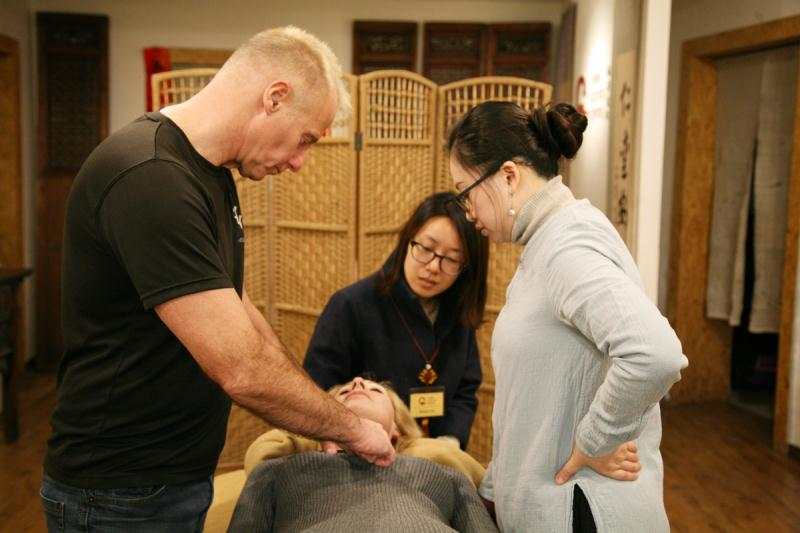
In the West this approach can also have merit. For example, knee pain could actually be caused by poor foot alignment or perhaps a weakness in the muscles around the hips i.e. above and below the site of pain. Or elbow pain can be caused by tight forearm extensors or an impingement in the neck. I also observed that acupressure is often used to relieve pain such as a headache or back injury. A thumb or elbow will be placed on a longitudinal line with the injury and pressure will be placed on the tissue for extended periods. The pressure will be following the line of Chi energy. In the West we will use very similar techniques to find and relieve “Trigger Points”: tiny areas of tissue that refer pain to other areas.

Admittedly some of the acupressure points identified to relieve specific conditions just did not make sense to my Western knowledge of physiology. For example, stomach problems may be treated by pressing the front of the elbow, knee pain may suggest an issue with the immune system. A sudden headache may be related to the solar plexus. However this holistic approach is not so dissimilar to some forms of Osteopathy and Kinesiology. It would seem likely that if these techniques haven’t had some degree of success then they would have been abandoned a long time ago.
It is, however, entirely possible to have a Tui Na treatment that is flowing and focussed on a specific area e.g. shoulder discomfort. The techniques are combined and wax can be used. The experience is quite similar to receiving our equivalent of a deep tissue massage. In Beijing the full-body treatment is often completed with a whole 30 minutes of deep kneading into the feet. It is more relaxing than it sounds!

In case you are a little sceptical about the idea of energy meridians flowing through the body , or you think Chinese Medicine is somewhat arcane then this may change your mind. Dr Huang offered to check the pulse of myself and a colleague. She palpated both the right and the left wrist. The left wrist pulse can give feedback on the heart, liver and kidney. The right hand pulse can provide feedback on the lungs, spleen and stomach. Dr Huang calmly sat for a few minutes intently focussing on what the pulse was telling her. In both of our cases she correctly diagnosed all of our existing and serious past ailments, even down to my dodgy right knee!
So, whilst there are many differences to the Western and Eastern approaches to remedial massage, there are also many similarities and it is clear two thousand years of Chinese Medicine can still teach us a thing or two!
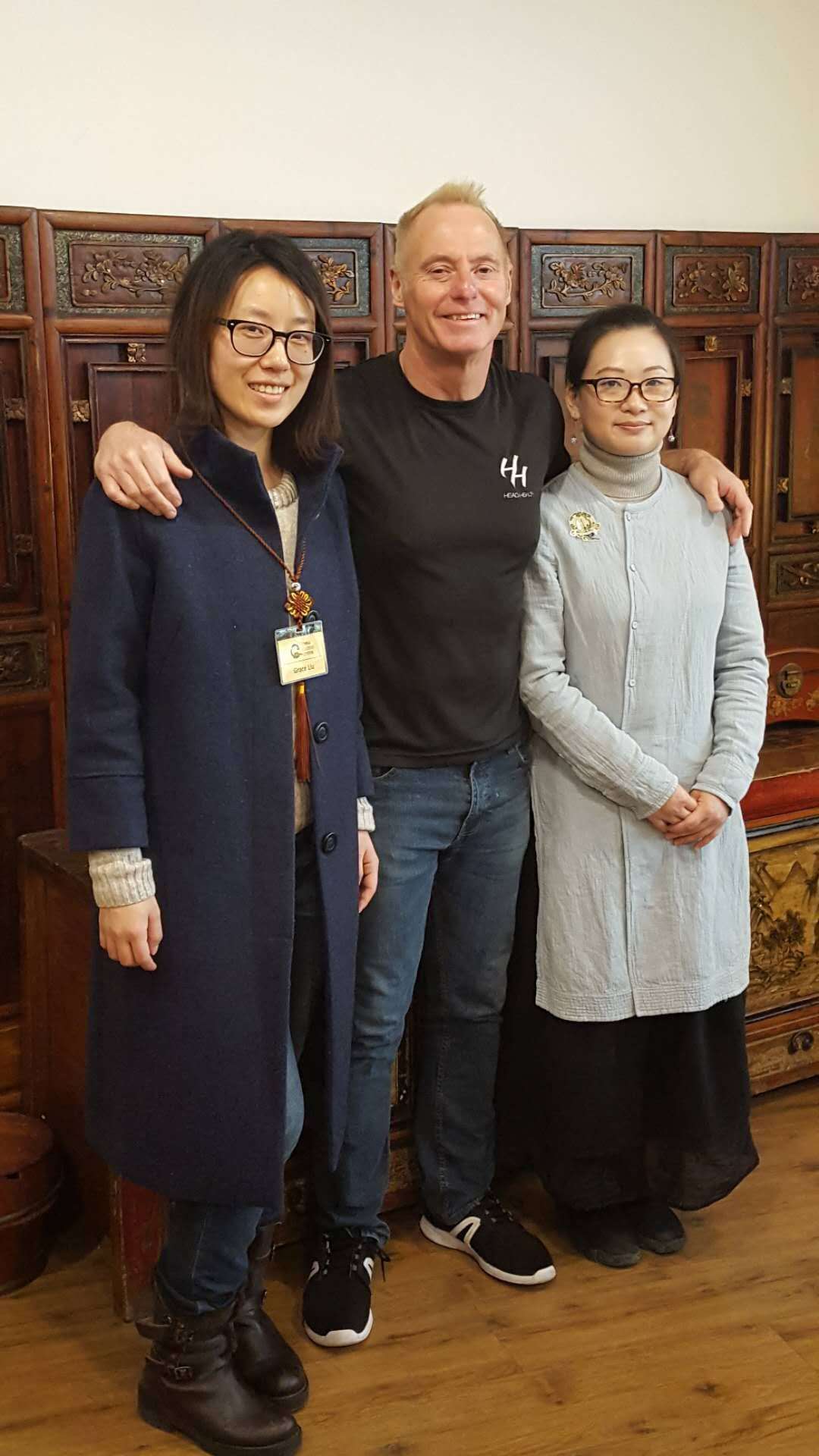
I would like to thank Dr Huang for imparting her knowledge, Grace Liu for her excellent translation skills, Dr Susan Wiltshire for being a willing body to work on(!) and everyone at the Chinese Culture Centre, Beijing for allowing me to participate.